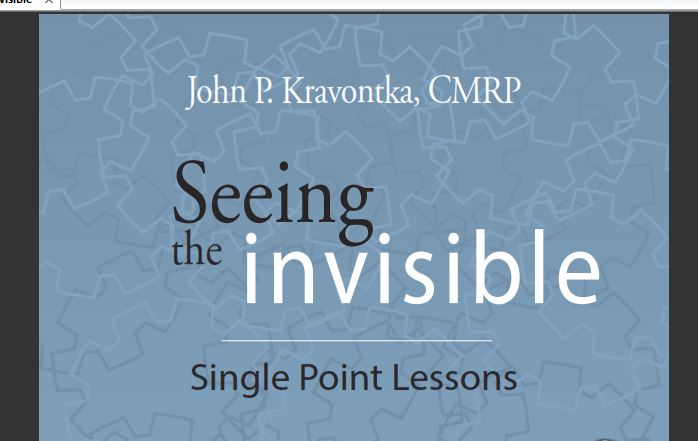
“Seeing the Invisible” by John Kravontka, and published by the Greater Boston Manufacturing Partnership (GBMP).
This introduction to the series talks about How to read a Single Point Lesson Plan.
This series will look at how to get out of the breakdown mode, and how to use countermeasures to approach world class maintenance. The series touches on Safety, 5S, TPM, Maintenance Excellence, with Lubrication Excellence, and Predictive Maintenance, OEE, Setup Reduction,, Energy and Environmental.
This was a terrific interview conducted by Davis Visco president of The 5S Store.
The interview discussed how TPM raises output and finds lost money.
If you want to understand how world class maintenance can improve your companies output and save money this is a must see interview
They discuss Operator Ownership, Maintenance and Operator Partnerships, TPM Focused Improvement Events, Contamination, Lubrication, Seeing the Invisible, Maintenance Histories, OEE, Maintenance Skills, Critical Equipment ,Critical Spare Parts, Equipment Improvement Teams, and Early Equipment Management.
T.his is a worthwhile look.
Rusty
Getting Your Equipment Running Safely, Productively & Reliably
Published May 30, 2013
This insightful interview from the President of Fuss & O’Neill Manufacturing Solutions – John Kravontka provides first hand insight into the mistakes, challenges and key principles needed to move from a mindset of keeping equipment running, to running at the highest and most efficient level. According to John, there are 5 pieces of the puzzle that everyone needs to know. He notes, “Operators treat equipment like a rental car, rather than as a valued piece of equipment that they actually “own” for which they take responsibility.” Get ready to take notes on the importance of setting standards and making your process easy, effective and trackable against daily operator performance. Also, click here to view this helpful PDF that illustrators the 5 pieces of this puzzle as detailed in this video. John is a masterful teacher of this view of the TPM process, so look forward to more contributions from him and his team at Fuss & O’Neill.
The five subject areas identified in the certificationguide are business management, people skills (organization & leadership), equipment reliability, process reliability, and work management (mostly maintenance planning, but also a bit of project management). Questions are drawn from these categories.
Plenty of time was given. There were 110 multiple-choice questions to be completed in 150 minutes. I initially answered all questions in 90 minutes and then spent another 30 minutes checking back over the entire test. having perused online bulletin boards, I found no one that took longer than 2 hours to completethe test.
Much less than half of the test was “technical.” If you don’t understand what vibration spectrum side bands are, you will probably still be fine. However, you will have to know what the major condition monitoring methods are, where and when to apply them, and some feeling (on the order of magnitude level) of what is “good.” Overall, the quantity of questions felt proportional to the five Body of Knowledge areas.
A calculator was required for 5-10% of the questions. The non-programmable calculator allowed in the test center was sufficient to answer any of those questions where a calculator was useful.
Real world experience and benchmarking knowledge are crucial to success. You should know how a maintenance planner should spend their time and what typical and “good” results are in a variety of M&R metrics. Know how to keep people involved and empowered without abdicating management responsibility for either the efforts or the results.
The Certified Maintenance & Reliability Professional (CMRP) program is the #1 credentialing program for certifying the knowledge, skills and experience of M&R professionals. It’s more than just committing textbooks to memory; it’s a thorough examination of individual expertise measured against a universal standard.
Every facility needs at least one CMRP on its team- and most should have more. They have the knowledge and skills to ensure efficiency and productivity on site- from technical skills and streamlined processes to performance management and managerial confidence.