Here is the latest installment of our video book report series “Seeing the Invisible” by John Kravontka and published by the Greater Boston Manufacturing Partnership.
Remember: We Read them, so you don’t have to.
I Found a good article from C.E.D. Compressed Air Inc. 
For many organizations, compressed air comprises a large part of an ever-growing utility bill, so now companies are beginning to analyze the true cost of compressed air leaks within their facility. The results show that compressed air leaks affect expenditures in a range of areas.
Compressor Sizing
Industrial firms purchase their compressors based on the demand in terms of air in the system. Air leaks can cause higher than necessary equipment expenditure and can also mean that equipment must be maintained on a more regular basis to ensure optimal performance in meeting demand.
Water Intrusion
In addition to allowing air out of the system, leaks tend to let moisture in. Water migrates from the high humidity outside air to the compressed air. This water migration can potentially cause cracks in valves as large amounts of water enter the system and overload components. Companies must then dip into their budget to replace any damaged components and conduct moisture removal maintenance on their systems.
Reduced Accuracy in Air Profiling
When leaks occur, they can prevent plant managers from achieving an accurate read in terms of their air profile. In leaks where the total leak load exceeds 10% of the overall load capacity, the artificial demand caused by the leaks can prevent companies from seeing the full picture of their plant efficiency. Such leaks can lead to wasted money on air audits and other efficiency improvement measures.
What do we need to do?
By taking a proactive strategy in managing and repairing air leaks within our compressed air equipment, companies can not only improve the performance of their equipment, but save thousands of dollars annually in terms of repair and maintenance expenditures.
Try this.
A one bar (14.5 psi) decrease in pressure reduces energy consumption by seven percent. And, if there are leaks in the compressed air system, the same pressure decrease reduces the impact of the leaks by 13 percent.
Also consider that, off hours can account for 25% of your compressed air energy use. Look at minimizing this usage, segment your system and turn off areas not in use during off hours..
Access to the latest leak detection systems is now required for the proactive industrial firm.
Investing in an Ultrasound System should be high on your list.
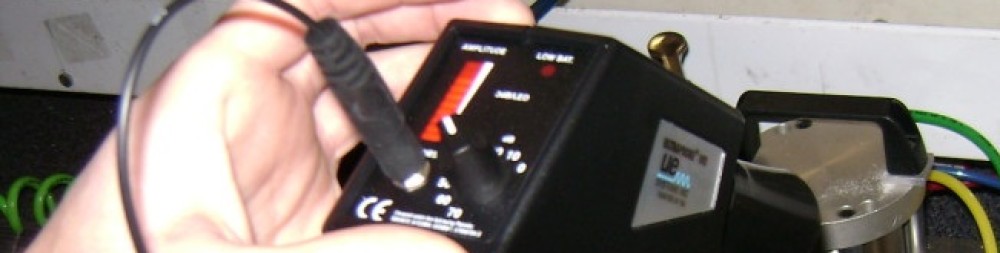
A major advantage to ultrasound leak inspection is that as a high frequency, short wave signal, ultrasound emissions tend to be localized around the leak site. By scanning an area with an ultrasound instrument, a user will follow the sound of the leak to the loudest point. Once identified, the leak amplitude can be noted and used in a compressed gas reporting tool, this cost analysis can tie dollars, for the use of maintenance time to fix leaks.
I have used UE Systems units, but you need to use something. The leaks are eating into your companies profits.
Leave me a comment if you have found a good way to get rid of your leaks.
Rusty
Here is a link to the CED article: http://cedcompressedair.ca/blog/what-is-the-cost-of-compressed-air-leaks/
Check out Episode #4 of the Maintenance Geek Video Book Report Series “Seeing the Invisible” by John Kravontka and published by the Greater Boston Manufacturing Partnership. This episode continues with the industrial safety theme, covering means of egress, wiring 5S, Pipe Insulation ,preventing slips and falls,open floor holes, lifting heavy components, ergonomics, simple green washers, and proper transport of loads.
Enjoy the Episode #4 of the video series.
Rusty Fixxer
Here is Episode #1 of “Seeing the Invisible” by John Kravontka and published by the Greater Boston Manufacturing Partnership,
Buy it at www.gbmp.com
This Episode will cover the section on safety… The foundation of Maintenance Excellence is coming home safe each day from work..
)
Enjoy Episode One.
Rusty

“Seeing the Invisible” by John Kravontka, and published by the Greater Boston Manufacturing Partnership (GBMP).
This introduction to the series talks about How to read a Single Point Lesson Plan.
This series will look at how to get out of the breakdown mode, and how to use countermeasures to approach world class maintenance. The series touches on Safety, 5S, TPM, Maintenance Excellence, with Lubrication Excellence, and Predictive Maintenance, OEE, Setup Reduction,, Energy and Environmental.
Here is an introduction to the series.
Buy it at www.gbmp.com
Rusty
Here is a link to who we are.
Greetings,
This was a terrific interview conducted by Davis Visco president of The 5S Store.
The interview discussed how TPM raises output and finds lost money.
If you want to understand how world class maintenance can improve your companies output and save money this is a must see interview
They discuss Operator Ownership, Maintenance and Operator Partnerships, TPM Focused Improvement Events, Contamination, Lubrication, Seeing the Invisible, Maintenance Histories, OEE, Maintenance Skills, Critical Equipment ,Critical Spare Parts, Equipment Improvement Teams, and Early Equipment Management.
T.his is a worthwhile look.
Rusty

This insightful interview from the President of Fuss & O’Neill Manufacturing Solutions – John Kravontka provides first hand insight into the mistakes, challenges and key principles needed to move from a mindset of keeping equipment running, to running at the highest and most efficient level. According to John, there are 5 pieces of the puzzle that everyone needs to know. He notes, “Operators treat equipment like a rental car, rather than as a valued piece of equipment that they actually “own” for which they take responsibility.” Get ready to take notes on the importance of setting standards and making your process easy, effective and trackable against daily operator performance. Also, click here to view this helpful PDF that illustrators the 5 pieces of this puzzle as detailed in this video. John is a masterful teacher of this view of the TPM process, so look forward to more contributions from him and his team at Fuss & O’Neill.
Contributing Writer: John Kravontka
– See more at: http://www.effectiveflowmagazine.com/interview/getting-your-equipment-running-safely-productively-reliably/#sthash.E4NnEV1U.dpuf